
How to Get Started with Foster Care or Adoption

Looking to become a foster parent or adopt through the foster care system, but don't know where to start? This post is for you! We often have conversations with people both online and in person who have a deep desire to begin the process, but feel overwhelmed by all of the details. We completely understand - the system can be confusing, but we are here to help! Let's break it down and take things step by step...
First, a disclaimer: The Salvation Army Children's Services is located in Southeastern PA, and this article will refer specifically to the Pennsylvania child welfare system. If you happen to be reading this article from another state, you will want to double-check which aspects of the process may be different in your state.

First things first: Is foster care or a foster care adoption right for you?
Many people don't realize that there are different pathways to adoption. If you are hoping to adopt, the first thing you need to do is evaluate what kind of adoption is right for you. Briefly, here is a quick rundown of the three primary types of adoption:
- Private Domestic Adoption (sometimes referred to as Infant Adoption) is the process of adopting a child - typically a newborn - whose birth parents choose to make an adoption plan for them.
- Inter-Country/International Adoption is the process of adopting a child from another country. The process and requirements vary depending on the country you are adopting from.
- Adoption from the Child Welfare System (sometimes referred to as a foster care adoption) is the process of adopting a child who has been removed from their family due to abuse, neglect, or the family's inability to care for them safely. Adoption from foster care only occurs after reunification efforts have first been extensively pursued, and it has been determined that the child cannot safely return to their parents or other biological family members.
Because The Salvation Army Children's Services works exclusively within the child welfare system, this post will be primarily focused on people who are open to the third type of adoption.
Foster care or a foster care adoption may be a good fit for you if:
- You want to help kids
- You have a desire to share your home and family with a child in need
- You are open-hearted, flexible, and resilient
- You are willing to learn about childhood trauma and how to support children from hard places
- You are open to supporting children's right to be with their birth families whenever safe and healthy
Foster care or a foster care adoption may NOT be a good fit for you if:
- You have your heart set on adopting an infant without fostering first. This is a little bit confusing, because many foster parents DO end up adopting children that they have cared for since they were very tiny. However, as mentioned above, the goal of foster care is reunification and when a newborn baby is placed in a foster home, efforts are first made to safely return them to their birth parents or find biological relatives or family connections (known as "kinship placements") for the baby. When all of those avenues have been exhausted, then the foster family will be offered the opportunity to adopt, but by the time the adoption is finalized that newborn will most likely be running around the courtroom as a sweet little toddler or even preschooler! Families who would like to adopt an infant without being involved in foster care first may find a better fit with private adoption.
- You do not want to have any interactions with a child's first family, because family connections are important to many children even after adoption, and should be honored and supported whenever possible.
- You would like to adopt without fostering first. All adoptions from the child welfare system, including children who are already legally free and placed with the goal of adoption, start with a period of foster care.
- You have a very busy, inflexible schedule. Adding one or more additional members to your family inevitably stretches your schedule - between medical appointments, sick days, extracurricular activities, and the everyday work of parenting. Add to that the extra time commitment of foster care - including birth family visits, therapy appointments, caseworker visits, court dates, and evaluations - and most foster families quickly find that something has to give. But don't worry. All kinds of families (including those where both parents work full-time) can make amazing foster families if they can be flexible, open-hearted, and creative.
If you would like to learn more about providing foster care, you can check out our previous post, Breaking Down the Different Types of Foster Care.

Your First Step: Choose an Agency
All foster parents, or those who adopt through foster care in Pennsylvania, must be licensed by a DHS-approved agency. Depending on where you live within the state, you may have the option of being licensed directly through your county's Children and Youth agency and/or by a private foster care agency like The Salvation Army Children's Services. Some, but not all, of the 67 PA county Children and Youth agencies license their own foster parents. Some rely exclusively on private agencies to provide foster homes, while others place children in both county-licensed and privately licensed homes.
If you live in a county that does license their own foster homes, you may be wondering whether it is better to be licensed directly through the county or through a private agency. There is no one-size-fits all answer to this question, and what is best may vary depending on your family's goals and needs.
Here are some factors you may want to consider in your decision:
- If you are licensed through the county, you can only receive placements from that county, whereas if you are licensed with a private agency you will have the option to accept placements from multiple surrounding counties.
- Counties typically place children in their own county homes first, and only refer children to private agencies who they have not been able to find a home for. Realistically, that means that infants, single children, and children without significant special needs often end up being placed in county homes.
- Agencies are often able to provide a higher level of individualized support and additional resources to foster families. However, some families prefer the simplicity of working directly with the county and not having a "middle man."
If you have determined that working with a private agency is a good fit for you, your next step is to choose which agency you would like to be licensed with. A common question that many people ask is whether they can be dual-licensed with the county AND a private agency, or licensed with two different agencies at the same time. The simple answer to this is no; families must choose one agency to complete the licensing process with. However, don't worry - there really isn't any reason to have more than one agency. Some people assume that if they have two agencies, they will receive twice as many referrals for placements, but this is not the case. The county typically sends the same referrals to all of their contracted agencies, and each agency in turn presents the county with any families they have who may be a fit for the child. The county then chooses which home they would like to place the child in. Agencies do not have their own "pool" of children - all children come from the county Children and Youth agency.
So how do you determine which agency is right for you? In PA, each agency must follow certain DHS compliance standards. That means no matter who you are licensed with, you will still have to meet the same basic requirements. However, agencies have some freedom in how they complete the process, and any additional requirements they may add. For example, The Salvation Army Children's Services requires that each of our foster and adoptive families is trained in Trust-Based Relational Intervention (TBRI) because we feel that it is an invaluable tool to help you learn how to parent children who have experienced trauma.
If you are looking agencies in your area, you can call the Statewide Adoption and Permanency Network (SWAN) at 1-800-585-SWAN. If you live within a one hour radius of Allentown, we would love to work with you at The Salvation Army Children's Services!

Your Second Step: Complete a Home Study
Once you have selected an agency, you will begin the process of becoming licensed. This process is called a home study. Contrary to popular belief, a home study is more than just a walk-through of your home - it is a process of getting to know you and your family and beginning to build a healthy working relationship with you. This process can not and should not be rushed. It can feel long and invasive, but just remember - the agency is tasked with the enormous job of ensuring that you can be trusted to safely and competently care for human beings. Just hang in there, trust the process, and remember that we WANT you to succeed. We are NOT nitpicking you and looking for reasons to deny you, but we ARE doing our due diligence to make sure that you are ready to be a successful foster or adoptive family.
Once the home study is completed, the agency will create a document all about your family. This document, known as a Family Profile, will contain all of the pertinent details about your family and your readiness to provide care to children, including information about any special training and skills that you may have. It will be used to share with counties when you are being presented as a placement resource for a child.

Your Third Step: Placement!
Once you are officially licensed by the county or agency, you will be open and available to receive placements. You can set the parameters of what age range, gender(s), number of siblings, race(s), and special needs you are willing to consider. Waiting for your first placement can be an exciting but also nerve-wracking time. We recommend using this time of waiting to focus on preparing yourself and your family in every way - physically, emotionally, spiritually, etc. Read books about trauma, talk to other foster parents, enjoy special times as a couple or family, or even squeeze in a vacation. One thing we have found to be extremely helpful to new waiting families is to offer to provide respite care. Respite care is short-term care for children placed in other foster homes who are needing a short break. Providing respite can help you go "get your feet wet" so to speak, learn about what kinds of kids are a good fit for your family, and practice parenting kids from hard places.
Many families wonder how much time they will have to wait before their first placement. The answer to this can depend on a wide variety of factors, including the kinds of children you are open to and current needs. Some families wait weeks or even months for their first placement, while others get "the call" immediately after becoming licensed (or even a few days before!). You will always be more likely to get placements if you are:
- Responsive
- Open to a wide range of ages
- Willing to take sibling groups
- Willing to take children with special needs
- Willing to take children on short notice, or with little information known about them
- Flexible and able to accommodate transportation to school and visits
If you are a licensed family and waiting for your first or next placement, we always recommend staying in regular communication with your agency and making sure they are up to date on your preferences. At The Salvation Army Children's Services, one of the ways we keep our waiting families engaged is to email them every single referral we receive - so even if they are not getting phone calls because we don't currently have children within their set parameters, they can actively see the kinds of referrals we ARE getting and have the option to express interest if they decide they might be willing to go a bit outside of their range. For example, a family might be waiting for a call about a child 0-5 but receive an email about a 7 year old and decide they would like to inquire about being a resource for them. We have made several placements this way, but more importantly, we feel it is an important way to be transparent with families and help them to see what we are seeing on our end.
Hopefully this article gave you some good first steps to take in your foster care and/or adoption journey. If you have questions or would like to start the process with The Salvation Army, please contact us - we would love to speak with you!
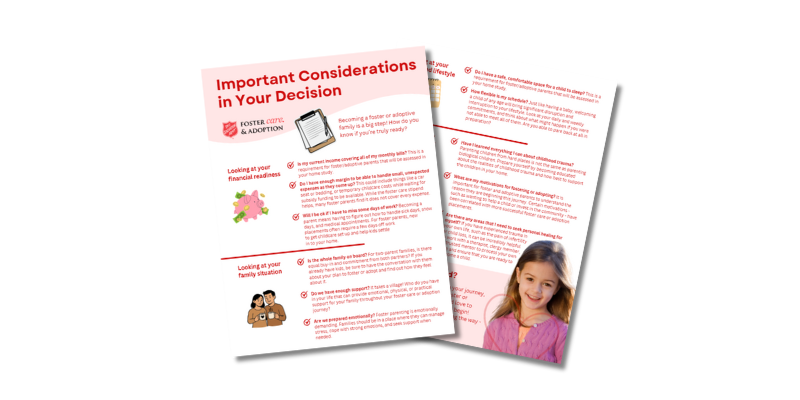
If you would like to learn more about how to determine whether you are ready to foster or adopt, you can download our free fact sheet, Important Considerations in Your Decision.
Want to stay connected? Sign up for our email newsletter here.